Small businesses in Middlesex County ask us the same question in different words: who can run the network cable, put in the rack, and get the Wi-Fi working without three separate vendors. We do that work every week from our shop in Bridgewater, a short drive from Piscataway, Edison, New Brunswick and Woodbridge. Here is how structured cabling and office network installation actually goes in the buildings this county is full of.
Key takeaways
- TrekTek Technologies installs structured cabling and office networks for small businesses across Middlesex County, NJ, from Bridgewater in neighboring Somerset County.
- One crew handles the cable, the rack, the firewall, the switches and the Wi-Fi access points, so there is one party responsible when something does not work.
- Flex and warehouse spaces in Piscataway, Edison and South Plainfield need overhead work, and our installers are OSHA trained and certified on scissor, boom and aerial lifts.
- Every drop is labeled at both ends, tested, and handed over on a floor plan you keep.
The buildings we see most in Middlesex County
The county is not one kind of office. The building decides most of the job:
- Flex and warehouse space. Piscataway, Edison, South Plainfield and Dayton are full of buildings with an office up front and open warehouse in back. Ceilings run 20 to 30 feet, there is no drop ceiling to hide cable in, and the runs back to the warehouse are long. Cable goes up in J-hooks or ladder tray, and access points go high on lifts.
- Older office parks. The 1980s buildings along Route 1 and Route 27 usually have drop ceilings, which helps, and old cable left behind by three previous tenants, which does not.
- Medical and professional suites. East Brunswick, Old Bridge and Monroe have a lot of small practices. These need more drops per room than people expect, and the exam room wall cannot be opened twice.
- Downtown storefronts and upstairs offices. New Brunswick, Metuchen and Highland Park buildings are older, often plaster, with limited paths between floors. Planning the route matters more than the cable itself.
One contractor for the cable and the network
A lot of offices end up with an electrician who pulled the cable, an internet provider who dropped off a modem, and somebody’s nephew who set up the Wi-Fi. When video calls start dropping, each one points at the others.
We install the whole stack and own the result:
- The cabling. Cat6 to the desks, Cat6A to the ceiling for access points and cameras, fiber between floors or buildings when the distance calls for it.
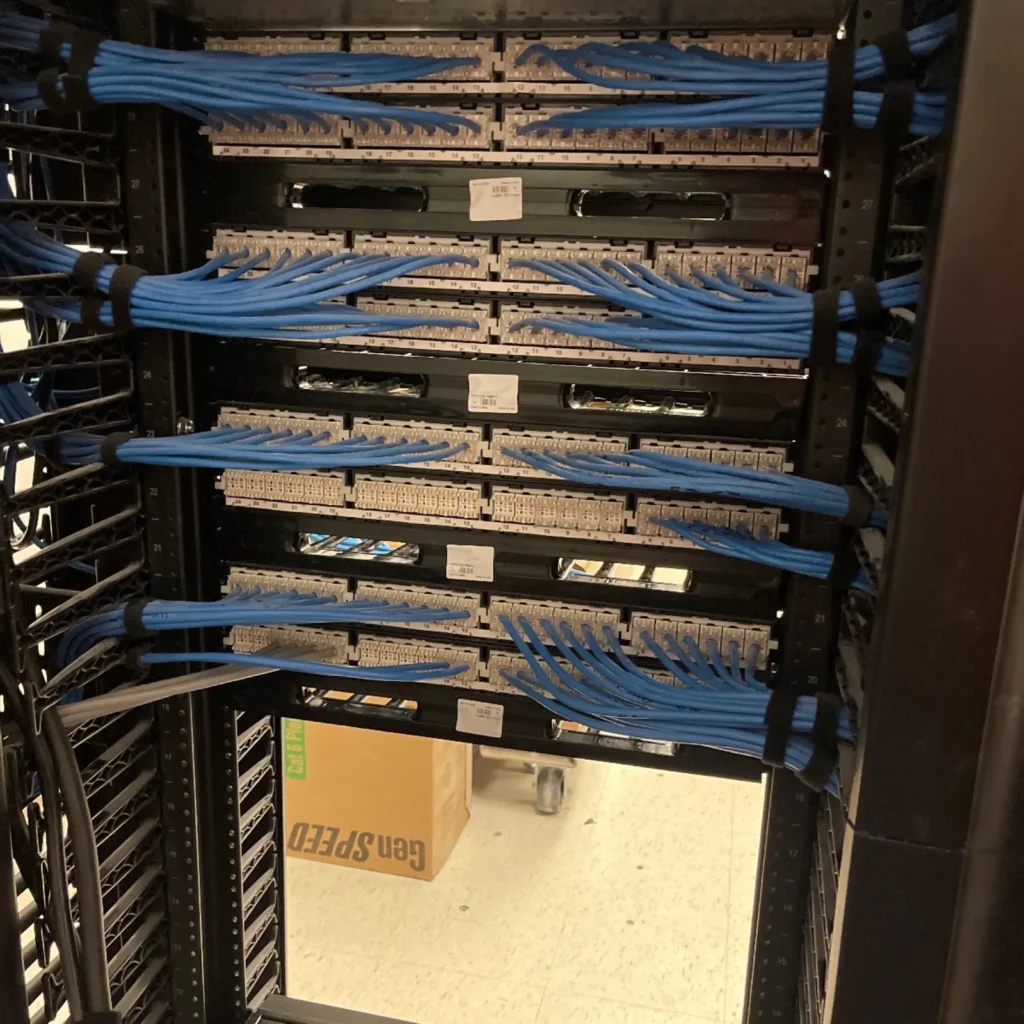
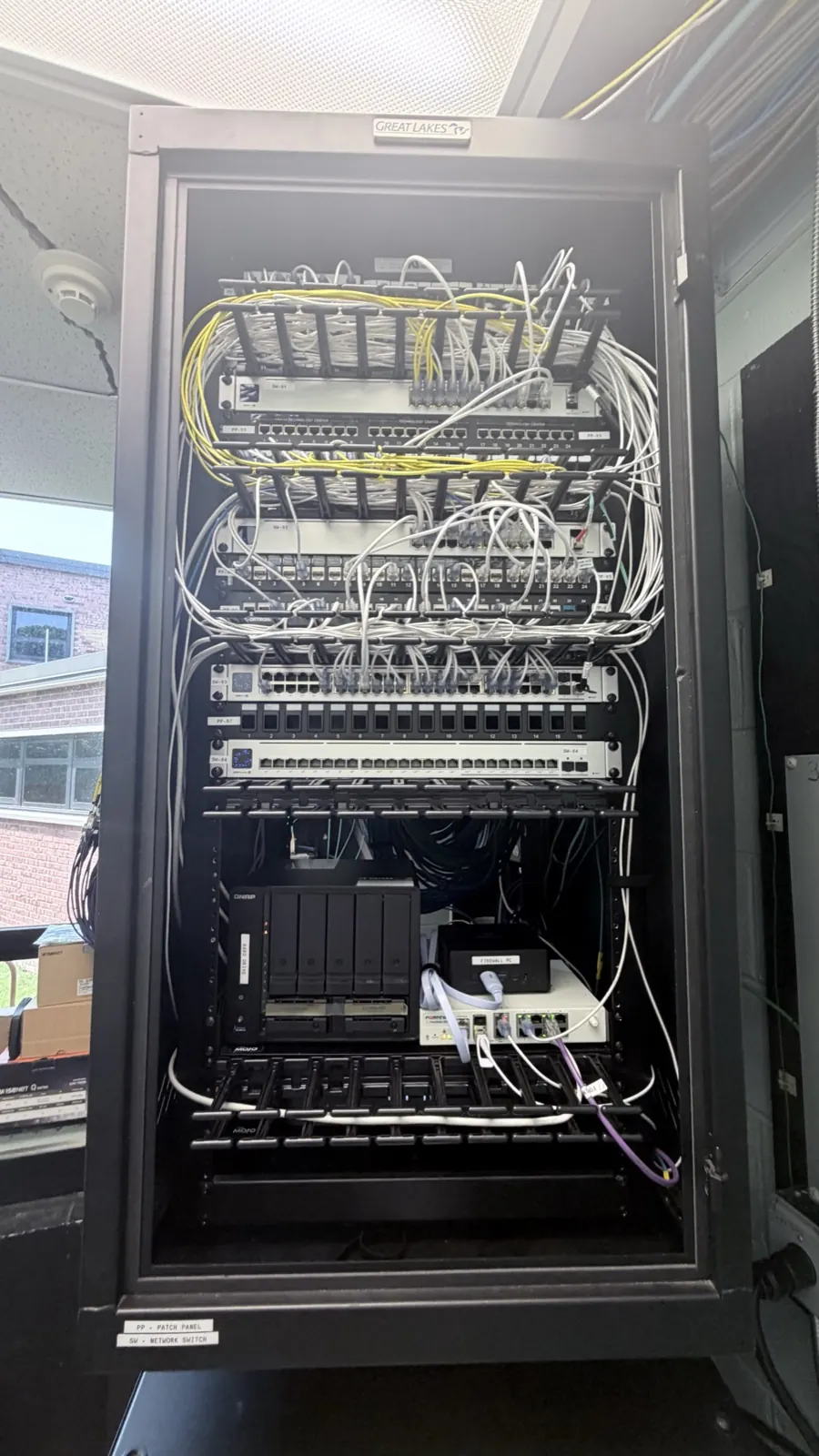
- The rack. A wall-mount or floor cabinet with patch panels, cable management and a battery backup so a power blink does not drop the phones.
- The firewall and switches. Business-grade equipment, usually Ubiquiti UniFi for small offices, with separate networks for staff, guests, phones and cameras.
- The Wi-Fi. Ceiling access points placed from a walk-through of the space, not from a guess on a floor plan.
More detail on what we install is on our structured cabling and networking page.
Warehouse and high-ceiling work
This is where small-office cabling jobs usually stall. Running cable across a 25-foot warehouse ceiling or mounting an access point over a racking aisle takes lifts, fall protection and people trained to use both. Our crew is OSHA trained and certified on scissor lifts, boom lifts and aerial work platforms. That means overhead runs, warehouse Wi-Fi and high-mounted cameras get quoted and done by the same crew that does the office up front, instead of being pushed off to another sub.
In a warehouse, we plan Wi-Fi around the racking. Full pallet racks block signal like walls do. A scanner that works fine in an empty building can lose connection the week the racks fill up, so we place access points for the building as it will be used, not as it looks on move-in day.
Moving into an existing suite
Most Middlesex County businesses are not building new. They are leasing a suite someone else had. Before you sign or before move-in, it is worth knowing:
- What cable is already there. Old Cat5e, unlabeled and untested, is common. Some of it can be reused after testing. Some of it should be pulled out.
- What the landlord requires. Many buildings require plenum-rated cable above the ceiling, a certificate of insurance, and work scheduled around other tenants.
- Where the internet comes in. The demarc is often in a shared electrical room down the hall. The rack should be close to it, or a clean run planned between them.
We will walk a space before your lease is signed and tell you what can stay and what has to change. Our office cabling checklist covers the questions to bring to that walk-through.
What the install looks like
A typical small office in Edison or Piscataway, ten to twenty-five people, goes like this. We walk the space, count devices by room, and mark the rack location and access point positions. Cable is pulled and terminated, usually in one to three days, often after hours if you are already working there. Every drop is labeled at both ends and tested. Then we mount the rack equipment, configure the firewall, switches and Wi-Fi, and move your devices over. You get a floor plan with every drop numbered, the network passwords in a sealed handoff, and a call with us when you add the next desk.
If the office has a conference room, the cabling for the display, camera and table connections should go in at the same time. Our guide to conference room AV for a small office covers what to plan for.
Frequently asked questions
Who installs structured cabling for small businesses in Middlesex County, NJ?
TrekTek Technologies installs structured cabling and office networks for small businesses throughout Middlesex County, including Piscataway, Edison, New Brunswick, Woodbridge and East Brunswick. We are based in Bridgewater in Somerset County and handle the cable, rack, firewall, switches and Wi-Fi as one job.
Can you cable an office while we keep working?
Yes. Most of our Middlesex County jobs are in occupied offices. We work after hours or in sections, keep the existing network running until the new one is tested, and cut over on a single evening or weekend.
Do you work in warehouses with high ceilings?
Yes. Our installers are OSHA trained and certified on scissor, boom and aerial lifts, so overhead cable runs, warehouse Wi-Fi and high-mounted cameras are done by our own crew. We plan access point placement around the racking so coverage holds up once the shelves are full.
We are a family-owned company with a 4.9-star rating across 70 Google reviews, which you can read on our reviews page. To start, lay out your drops, rack and access points in the Project Builder, or send us a floor plan of the suite and we will tell you what the job needs.
Want a number for your place?
Build your project in a minute and see a starting-at price, or send us a few photos and we'll quote it.